
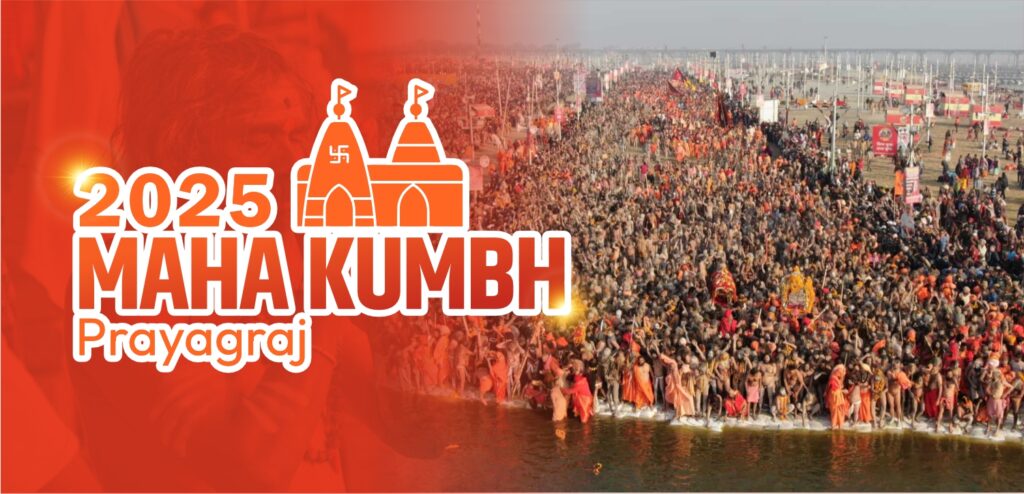
Maha Kumbh Mela: The Ultimate Spiritual Event
| Aspect | Details |
| Frequency | Every 144 years at Prayagraj |
| Peak Attendance | 50+ million in 2025 |
| Holy Sites (4) | Prayagraj, Haridwar, Ujjain, Nashik |
| Main Baths | Shahi Snans on auspicious tithis |
| Infrastructure | 4,000 ha city, AI surveillance |
| Mythical Basis | Samudra Manthan Amrita drops |
The Maha Kumbh Mela is known as the largest peaceful human gathering on earth. It attracts nearly hundred million devotees, every 144 years, to the sacred river Ganga and the place where it merges with the river Yamuna and the mythical river Saraswati, to perform rituals, which means bathing at the holy Triveni Sangam of Purification, immortality and unity.
This event continues to evolve from a mere fair along the river to building a gigantic temporary city of faith and devotion. The event and its organization are a testimony to the survival of humankind’s perennial quest for renewal through spirituality in the midst of modern challenges.
Mythological Foundations
The very essence of the Maha Kumbh is the myth of the Samudra Manthan, where deities and demons took turns to milk the divine ocean of the water of life and thus the nectar of immortality. The demons, however, made it their own and dropped it at four places—Prayagraj, Haridwar, Ujjain, and Nashik—waypoints on the divinity’s path through the universe, which happened to coincide with certain planetary alignments.
Yogi’s bathing on these days such as Mauni Amavasya leads to moksha (liberation) and sin removal, hence astronomy and devotion go hand-in-hand as per Vedic traditions. The lands marked by drops of the nectar are engaged in Kumbh Melas every 12 years, but the Maha Kumbh happens only after 12 such cycles, or, 144 years, hence its different and powerful nature is highlighted. The 2025 event in Prayagraj, for example, will happen during the rare Jupiter-Sun positions, thus, over 50 million people will come to bathe on the peak days.
Historical Development
The earliest mentions of such gatherings date back to the account of the Chinese traveler Xuanzang, who in 644 CE spoken about the opulent Prayag assembly of King Harsha, where the rulers gave huge amounts to the hermits. The philosopher Adi Shankara in the eighth century made a formalization of melas to promote philosophical discussions between different Hindu sects, and he even created monastic orders or akharas that are still present in the processions today.
The Mughal emperors, especially Akbar, provided sponsorship for the religious events even though there were differences among religions, thus, they made sure that the pilgrims would pass safely, and they also made them mingle. During the British era, development in communication such as the trains brought about increased participation, while the struggle for independence witnessed the leaders making the people at the events their alliance—Gandhi and others spread their ideas of nationalism here. After 1947, events such as the 1989 Prayagraj mela with 30 million visitors marked its global attraction with the help of technology.
Organization and Scale
Modern Maha Kumbh changes the city of Prayagraj into a large eco-city of 4,000 hectares, with 25 sectors, 150,000 tents, 3,000 kitchens, and more than 150,000 toilets, which include mobile toilets as well as VIP ones. The government sends 40,000 security staff, 67,000 LED lights, 2,700 AI cameras, 1,250 km of water pipes, and 488 km of roads for the smooth handling of the event. In 2025, more than 52.5 million people were baptized in only two days, which a logistics.
The ascetics of different akharas parade with the Naga sadhus during the Shahi Snans on the special dates, and the viewers are treated to the delightful visual of orange-garbed ascetics amidst the chanting crowd. The river cleaning, digital ticketing, and hygiene campaigns demonstrate the green measures taken during the event.
Cultural and Social Impact
Maha Kumbh is mainly a religious event, but it also functions as a unifier of diverse points of views and cultures, thus, the giant mural of sadhus, families, and tourists created by the festival promotes the values of tolerance and the sharing of the important parts of the heritage. It delivered establishments such as Banaras Hindu University in 1906 and the Vishva Hindu Parishad in 1964, which were rotating educational and political spheres.
It has an impact on the local economy by providing a market for the crafts and arts, and it also offers a variety of services in hospitality, while the local culture is enriched through folk dancing, singing of hymns, and dialogues.
Health camps and disaster preparedness have transitioned to be the community’s reflections, changing the ancient religious practice to modern-day requirements. The pilgrims consider it a life-changing experience—purifying their innumerable years of karma in the holy river’s water.