
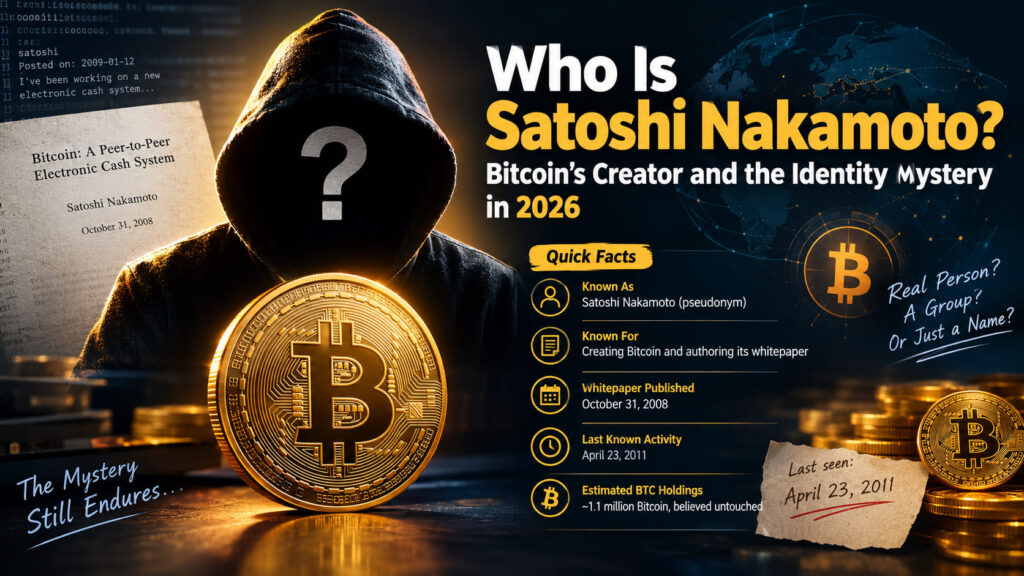
Who Is Satoshi Nakamoto? Bitcoin’s Creator and the Identity Mystery in 2026
More than seventeen years after the Bitcoin whitepaper first appeared online, the identity of its author, Satoshi Nakamoto, remains one of the internet’s greatest unsolved mysteries. In 2026, with Bitcoin firmly established as a trillion-dollar asset class, interest in Satoshi’s true identity hasn’t faded — if anything, it’s grown, as the roughly 1.1 million Bitcoin believed to belong to the creator continues to sit untouched, worth a fortune that would rank among the largest in the world.
Quick Facts
| Known As | Satoshi Nakamoto (pseudonym) |
| Known For | Creating Bitcoin and authoring its whitepaper |
| Whitepaper Published | October 31, 2008 |
| Last Known Activity | April 23, 2011 |
| Estimated BTC Holdings | ~1.1 million Bitcoin, believed untouched |
Who Is Satoshi Nakamoto, Really?
Satoshi Nakamoto is the name attached to whoever wrote the Bitcoin whitepaper, “Bitcoin: A Peer-to-Peer Electronic Cash System,” and it may not represent a single person at all. Nakamoto communicated only online — through forum posts, emails and code commits — using precise, formal English and a working style that showed no obvious geographic or cultural fingerprint. That anonymity was almost certainly deliberate, given how central decentralization and trustlessness are to Bitcoin’s entire premise.
How Bitcoin Was Born
Nakamoto released the Bitcoin whitepaper on the Cryptography Mailing List on October 31, 2008, in the middle of the global financial crisis — timing many believe was intentional commentary on trust in centralized banking. The Bitcoin network went live in January 2009, and Nakamoto remained an active, hands-on contributor to the project’s early code and community for roughly two years before disappearing.
The Leading Theories on Satoshi’s True Identity
No shortage of candidates have been proposed over the years, each with circumstantial evidence and just as many holes:
- Hal Finney — An early cryptographer who received the very first Bitcoin transaction and lived near a man named Dorian Satoshi Nakamoto. He denied being Satoshi before his death in 2014.
- Nick Szabo — Creator of “Bit Gold,” a Bitcoin precursor. Writing-style analysis has found notable similarities between his work and the Bitcoin whitepaper.
- Dorian Nakamoto — A California engineer whose birth name is literally Satoshi Nakamoto. Newsweek named him as the creator in 2014; he denied it, and a post from Satoshi’s own account stated, “I am not Dorian Nakamoto.”
- Craig Wright — An Australian computer scientist who publicly claimed to be Satoshi starting in 2016. A 2024 British court ruling found he did not write the whitepaper and had never moved any of the early Bitcoin holdings.
- The Collective Theory — The idea that several cypherpunks — possibly including Finney, Szabo and Hashcash creator Adam Back — collaborated under one shared pseudonym.
- Adam Back — Inventor of Hashcash, directly cited in the Bitcoin whitepaper. He has consistently and firmly denied being Satoshi.
The 1.1 Million Bitcoin That Never Moved
Blockchain analysts widely believe Satoshi mined roughly 1.1 million BTC in Bitcoin’s earliest days — a stash that has never been spent, transferred, or otherwise touched since 2011. That sum places “Satoshi Nakamoto” among the wealthiest individuals or entities on Earth on paper, yet the coins’ complete inactivity is itself one of the strongest clues to the creator’s intent: whoever holds the keys appears to have deliberately walked away rather than cash out.
Why the Mystery May Never Be Solved
Nakamoto’s final forum message, posted April 23, 2011, gave no indication of stepping away permanently — just a passing note about moving on to other projects. No verified communication has surfaced since. Every legal attempt to force a resolution, including Craig Wright’s yearslong claim, has only reinforced how carefully the real Nakamoto covered their tracks, and cryptographers generally agree that without the original private keys being used to sign a message, no claim can ever be definitively proven.
Frequently Asked Questions
Is Satoshi Nakamoto a real person’s name?
No — it’s widely believed to be a pseudonym, and it’s unconfirmed whether it represents one person or a group working together.
How much Bitcoin does Satoshi Nakamoto own?
Blockchain researchers estimate around 1.1 million BTC, mined in Bitcoin’s earliest days and never spent or moved since 2011.
Has anyone proven they are Satoshi Nakamoto?
No. Every public claim, including Craig Wright’s, has failed to hold up under legal and technical scrutiny; a 2024 UK court ruling rejected Wright’s claim outright.
When was Satoshi Nakamoto last active?
Nakamoto’s last known public message was posted on April 23, 2011, after which all direct communication stopped.
Why did Satoshi Nakamoto disappear?
No one knows for certain. Theories range from a deliberate choice to protect Bitcoin’s decentralized ideals to concerns about personal safety or legal exposure.
The Bottom Line
Satoshi Nakamoto may be the most consequential anonymous figure in modern financial history — the architect of an asset class now worth trillions, who chose to vanish rather than cash in. Until someone can cryptographically prove ownership of the original wallet, the identity behind Bitcoin will stay exactly what it has been for over a decade: an open question the entire crypto world keeps asking.