
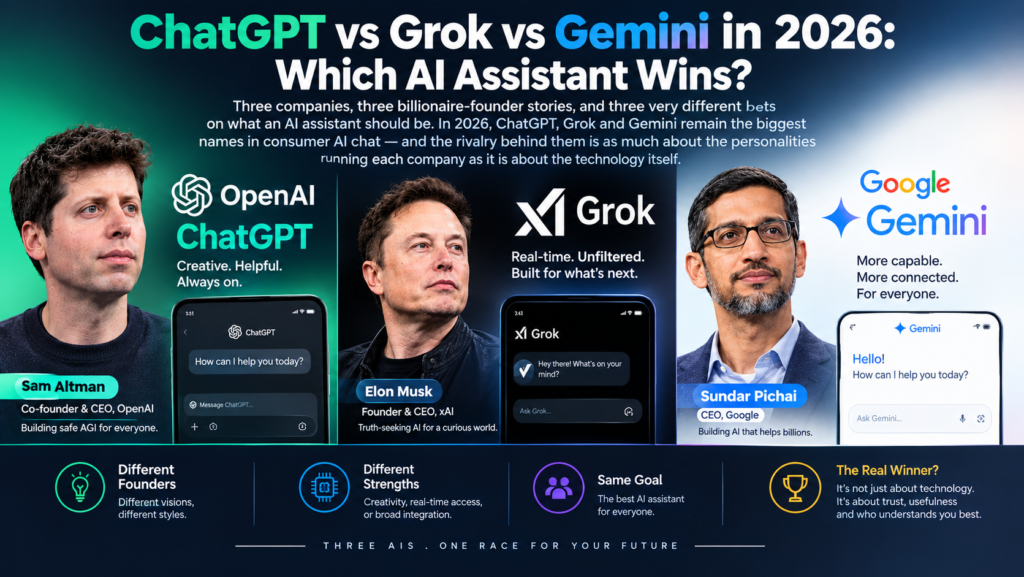
ChatGPT vs Grok vs Gemini in 2026: Which AI Assistant Wins?
Three companies, three billionaire-founder stories, and three very different bets on what an AI assistant should be. In 2026, ChatGPT, Grok and Gemini remain the biggest names in consumer AI chat — and the rivalry behind them is as much about the personalities running each company as it is about the technology itself.
Quick Facts
| ChatGPT | OpenAI · Sam Altman · GPT-5.5 Pro / o1 Pro · from $20/mo |
| Gemini | Google DeepMind · Sundar Pichai / Demis Hassabis · Gemini 3.1 Pro · from $19.99/mo |
| Grok | xAI · Elon Musk · Grok 4.20 · from $40/mo |
Meet the Three Companies Behind the World’s Top AI Chatbots
Each of these assistants is backed by a company with a distinct origin story and strategic focus. OpenAI, co-founded by Sam Altman and now the world’s most valuable AI lab, built ChatGPT into the default general-purpose assistant. Google DeepMind folds Gemini directly into the Google ecosystem millions already use daily. And xAI, Elon Musk’s AI venture, built Grok around direct access to real-time data from X.
ChatGPT (OpenAI) — Sam Altman’s All-Rounder
Running on GPT-5.5 Pro and o1 Pro, ChatGPT continues to lead in content creation and coding tasks. Its Computer Use feature, which allows the model to control a screen and automate tasks directly, has become one of its most distinguishing capabilities heading into 2026, reinforcing OpenAI’s positioning as the most versatile of the three.
Gemini (Google DeepMind) — Built for the Google Ecosystem
Gemini 3.1 Pro stands out for one number in particular: a 2.1 million token context window, the largest of the three by a wide margin, making it especially strong for research and long-document analysis. Its deep integration with Gmail, Docs and Sheets gives it a natural home-field advantage for anyone already living inside Google Workspace.
Grok (xAI) — Elon Musk’s Real-Time Challenger
Grok 4.20 introduces four-agent parallel reasoning and leans hard into its unique advantage: native, live access to the X data stream. For anyone tracking breaking news or real-time social sentiment, Grok’s positioning as the tool that “wins for real-time social data and live trend tracking” is a deliberate and differentiated bet.
Head-to-Head: Pricing and Strengths
- ChatGPT Plus: $20/month — best all-around versatility, strong coding and content tools
- Gemini Advanced: $19.99/month — largest context window, deepest productivity integration
- Grok Premium+: $40/month for the flagship model — best real-time insight and social data access
Which One Should You Actually Use?
The honest answer depends entirely on your workflow: ChatGPT for general content and coding, Gemini if you’re already deep in Google’s productivity suite and need to process long documents, and Grok if real-time information and social trend tracking matter more to you than raw versatility.
Frequently Asked Questions
Which is better in 2026: ChatGPT, Grok, or Gemini?
There’s no single winner — ChatGPT leads in general content and coding, Gemini in productivity and document analysis, and Grok in real-time social data and live trend tracking.
Who founded the companies behind ChatGPT, Grok and Gemini?
ChatGPT comes from OpenAI (Sam Altman), Grok from xAI (Elon Musk), and Gemini from Google DeepMind (under Google’s Sundar Pichai and DeepMind’s Demis Hassabis).
Which AI chatbot has the largest context window in 2026?
Gemini 3.1 Pro leads with a 2.1 million token context window, the largest among the three.
Which AI chatbot is the most expensive?
Grok’s flagship Premium+ tier costs $40/month, more than double ChatGPT Plus and Gemini Advanced, which are priced around $20/month each.
What makes Grok different from ChatGPT and Gemini?
Grok has native access to X’s live data stream, giving it a real-time edge for tracking breaking news and social trends that the other two don’t directly replicate.
The Bottom Line
The ChatGPT-Grok-Gemini rivalry is really a proxy war between three very different visions for AI — versatility, ecosystem integration, and real-time awareness — led by three of the most talked-about figures in tech. Expect the gap between them to keep narrowing as each company races to close its weakest point.