
On June 2, 2023, three trains of the Indian Railways, including two express trains and a goods train were involved in a tragic accident, that resulted in the death of more than 200 people and over 500 were injured. The accident involved Train no. 12841 Shalimar-Chennai Coromandal Express and Train no. 12864 SMVB – HWH Superfast Express, both of which got derailed near the Bahanaga Bazaar Railway station in the Balasore district of Odisha at around 18.55 Hrs on Friday. A lot of people on Twitter are asking the Railway Minister Ashwini Vaishnaw why the indigenous anti-collision technology ‘KAVACH’ didn’t stop the accident from happening?
What Is KAVACH Technology?
KAVACH is an anti-collision technology developed in India to prevent train accidents. This anti-collision technology reduces the chances of an error to the margin of a single error in 10,000 years. Affirming the facts, Railway Minister Ashwini Vaishnaw previously said, “The indigenously-developed anti-collision technology is SIL4 certified, which means there is the probability of a single error in 10,000 years.”
The KAVACH technology, in more technical terms, is known as Train Collision Avoidance System (TCAS) or Automatic Train Protection System (ATP) system. It is aimed at bringing down the number of rail accidents to zero. The technology has also received a SIL4 certification, reinforcing that it can reduce the chances of error to one in 10,000 years.
As the gate approaches, Kavach automatically initiates whistling without any intervention from the driver.
Auto whistle test is done successfully. #BharatKaKavach pic.twitter.com/02WrSJ1MYl
— Ashwini Vaishnaw (@AshwiniVaishnaw) March 4, 2022
Did ‘KAVACH’ Fail?
While initial reports suggested that the Coromandal Express train collided head-on with a goods train causing the derailment of four coaches of the superfast passenger train, Railway officials denied it. As per the initial investigation, the Train no. 12864 SMVT Bengaluru – Howrah Superfast Express derailed and crossed the adjacent track from where the Coromandal Express was passing. The Express train and also derailed near the Balasore district of Odisha, that resulted in derailment on another goods train.
Since all the train derailed, KAVACH technology didn’t work on such cases. As the name suggests, KAVACH is made to avoid head on collisions between engines of two trains. Another possible explanation is that the technology is not installed on all the network and this section was without the KAVACH technology. During the Budget 2022, Finance Minister Nirmala Sitharaman announced protecting the 2,000 km railway network in India by KAVACH technology.
The aforementioned technology will be brought in 2022-23 under the Atmanirbhar Bharat mission. In her statement, the Finance Minister said, “As a part of Atmanirbhar Bharat, 2,000 km of the rail network will be brought under the indigenous world-class technology KAVACH in 2022-23, for safety and capacity augmentation.”
How Does KAVACH Work?
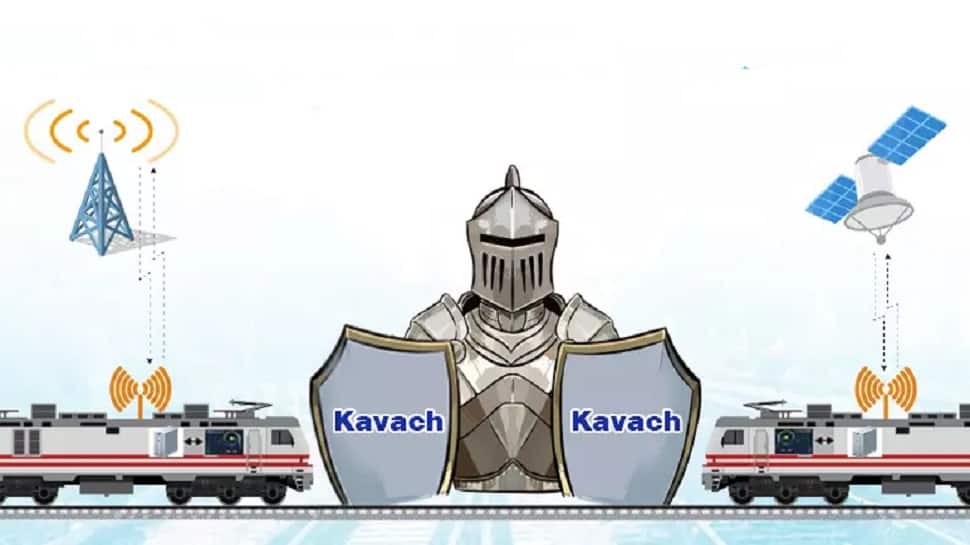
KAVACH uses a network of devices mounted on two trains moving towards each other to avoid a collision. The devices work with the help of radio technology and Global positioning systems (GPS). This system avoids the risk of collision by precisely assessing the course of two trains at “collision risk” and automatically initiating the braking system.
Basically, this technology warns the loco pilots about any incoming train, and stops the train automatically, by applying the emergency brakes. This happens when two trains are approaching each other on the same track. In this case, one train derailed on another track, resulting in such a massive incident.